It’s early morning and I just got back from a walk.
It’s part of my daily routing and I do my best to walk first thing in the morning every day.
Nowdays there are a variety of gadgets that allow us to measure the number of steps we take every day.
It’s no secret that the recommended magic number of steps per day is 10,000.
The reality is that not every day is the same and I do not always have the same time, which means that the time and distance I walk varies every day.
For me the important thing is to be consistent with how often I walk, regardless of how many steps I take and for how long I do it.
In other words my goals are long term and that is how I measure my results.
In a way, the same thing happens with content creation.
Recently I received the following question: What is the right length for a blog post?
I thought this was an excellent question, so let’s dive right in:
What is the right length for a blog post?
I wish I could give you an exact answer, but the truth is that it depends.
You may be curious and want to know how many paragraphs or how many words your content should include.
It’s a difficult question to answer, because the answer depends on many factors.
You see, you not only need to take into consideration the average time that scientifically a person dedicates to reading a post, you also need to consider the medium you use and also the goals of your strategy.
According to Time , 55% of visitors spend 15 seconds to read the content of your articles.
There are different opinions on how long a post should be because things have changed a lot in recent years.
In my opinion, the quality is more important than the length of the content.
Below are some interesting studies mentioned by lean-labs
- According to Medium, the length and ideal reading time of a post is 1600 words and the time to read it is 7 minutes
- According to SERPIQ , if what you are looking for is to position your web page in Google, the content must have between 2350 and 2500 words.
- Moz reported that if what you are looking for is to generate links, when a post is between 1800 and 300 words it will attract more links.
- According to Neil Patel, when a post has at least 1500 words the results are better from the point of view of SEO results and Social Media.
In order to help me you make the best decision about how long, here are 4 questions you need to answer that will help you make the best decision about what is the right length for a blog post:
4 Questions you need to answer to decide what is the right length for a blog post
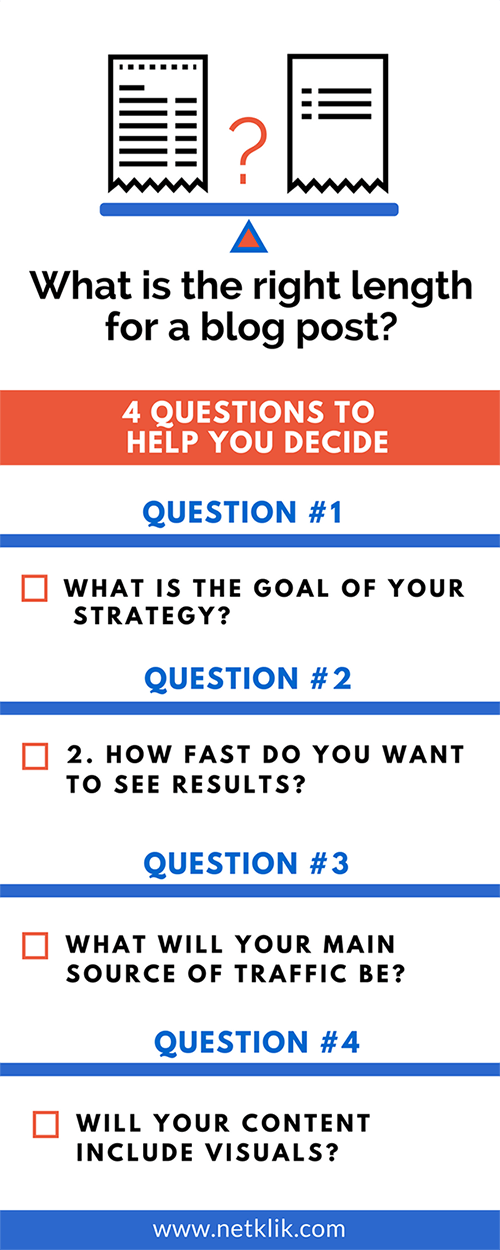
1. What is the goal of your strategy?
If you have a clear vision of the goal of your content strategy you can design a strategy that allows you to reach your goals.
It is not about writing content just because everyone does it.
Every post you write must have a goal and you must be able to track the results of each post effectively.
Once you have a clear vision of your goal, you will have a better idea of what type of content is best for your strategy.
2. How fast do you want to see results?
If there is something I have learned, it is that you need to set a deadline to reach your goals.
We know what happens when there is no deadline.
Nothing.
The speed with which you want to achieve your goals affects the types of content you must create.
If you have more time you can include longer content. If your strategy is short term, you simply do not have time to work on long content and your best option is to write short content.
3. What will your main source of traffic be?
The type of content can vary depending on how you plan to generate traffic: If part of your plan is to generate traffic from Google, you must write longer content and your strategy needs to be medium and long term.
However if you plan to generate traffic with social media, you can think of a short-term strategy and include short content.
The scenario changes completely if you can generate traffic paying for advertising, the type of content you must create depends on the medium you use, whether Google or social media.
I have created an infographic that includes the 4 questions that you must answer to help you decide: How long should a blog post be?
Please attribute the infographics to Netklik.com
Use the embed code I’ve included
<div>
<a href="https://www.netklik.com/online-marketing-strategies/right-length-blog-post/"><br>
<img class="alignnone size-full wp-image-1265" src="https://www.netklik.com/wp-content/uploads/2017/04/what-is-the-right-length-for-a-blog-post-infographic.png" alt="what is the right length for a blog post" width="500" height="1250" /></a>
</div>
<div>
Infographic by:
<a href="https://www.netklik.com/online-marketing-strategies/right-length-blog-post//">Netklik</a>
</div>
4. Will your content include visuals?
According to Lean-Labs , it turns out that visual content counts as words.
When you include images in your content, the content automatically becomes longer.
In addition, Moz reports that including visual content can help generate more links to your content, which in turn also has positive effects for SEO.
According to blogpros , the most popular blog posts include one image every 350 words.
Comparing short vs. long content
In short, both types of content have advantages and disadvantages.
If you decide to use short content for the post of a blog
The biggest advantage of producing short content is that if your goal is to produce more content, writing short content will allow you to produce content more often.
When you create short content you need to be able to communicate your message quickly and effectively.
You may also have less time to promote each post.
The key is to have a system in place that allows you to promote the content, because there is no use to creating content if no one sees them.
If you decide to use long content for the post of a blog
If your goal is to produce longer and deeper content you’re probably going to be on good terms with Google.
However you need to understand that’s it’s not just about writing longer content, your goal needs to be to create valuable content.
In addition, you need to make the content interesting, so people actually read the content.
Writing longer content, usually means writing less frequently, which in turn means you can spend more time promoting each post.
Conclusion
The reality is that the decision about what is the right length for a blog post
will depend on your strategy and you will not know until you try and experiment.
It’s not about counting words, paragraphs or images.
It’s about using content that sparks curiosity and captures the attention of your audience.


Leave a Reply